- UL 1123
Certified to Save: How UL 1123-Certified Life Jackets Help Prevent Drowning
Abstract
Drowning causes the death of thousands of children in the U.S. every year. Even under supervision, a child can drown quickly and silently, so parents and guardians often turn to various personal flotation devices (PFDs) to protect their children until they learn how to swim safely. Though some swim aids may seem safe, life jackets certified to UL 1123, the Standard for Marine Buoyant Devices, provide the best protection for swimmers of all ages across a wide range of applications. Certification to UL 1123 requires passing several tests for functionality, such as a jump test into water and a turning test to ensure the wearer will be turned face-up even if they do not know how to swim — the successful results of which could make the difference between drowning and survival.
Learning Objectives
- Understand the prevalence of children drowning in non-natural bodies of water, such as pools and hot tubs.
- Apply self-reflection to consider the amount of risk you would take to swim with or without a flotation device.
- Analyze real-world scenarios to deduce personal flotation device (PFD) construction requirements for various users.
- Evaluate efforts to educate the public about PFD safety and defend suggestions for improving overall water safety.


Real-world context
Drowning is the leading cause of injury-related death among children ages 1 to 4.
But there are risks
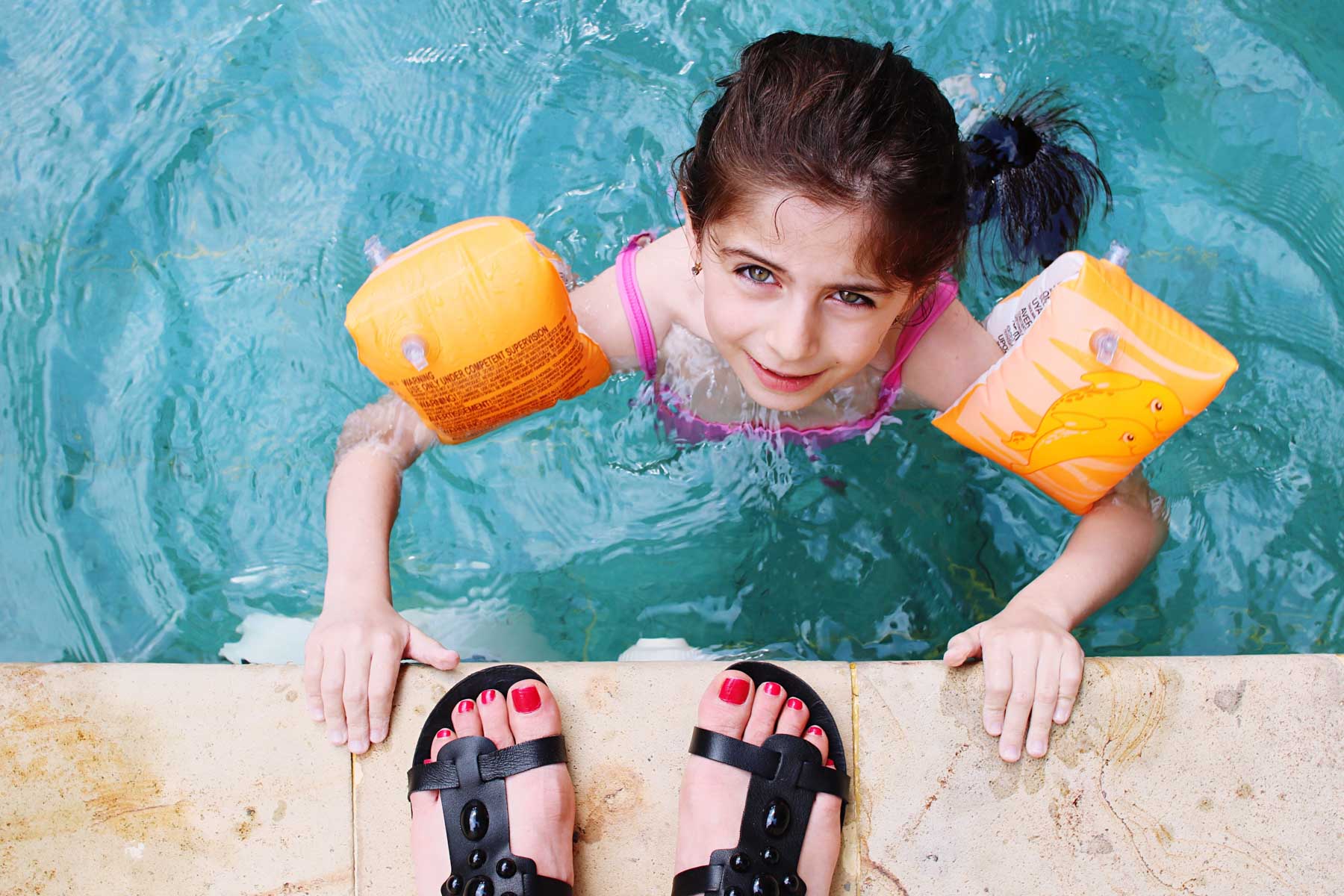
Water wings or cheap toys might seem helpful for learning how to swim, but these toys are not necessarily designed to teach children how to swim or to save the life of a child when they fall into water.
For example
Judah Brown was trying to learn to swim with a swim aid known as a puddle jumper that held him upright in the water. Judah died at 3 years old when he entered the pool without a flotation device, thinking he could “swim” upright, and sadly drowned.

How can parents safely support their children’s development in the water while ensuring they are protected from drowning?
Background
Imagine a hot summer day in the backyard with three families and a handful of kids all having a good time. Suddenly, the six adults realize that one of the children, a 2-year-old, has gone missing. Rachel Barton Lister frantically searched for her daughter and found her floating face down in a nearby hot tub only minutes later. Lister recounted, “My daughter made no noise. She couldn’t. She didn’t splash. She didn’t yell for help. We were all standing 10 feet away while she drowned.” 1 Fortunately, her daughter survived thanks to immediate CPR, sedation, intubation, and hospitalization. Other parents are not as lucky — in May 2025, influencer Emilie Kiser’s 3-year-old son died six days after drowning 2, one of thousands of children who drown every year in the U.S.
Drowning is a known risk to young children and adults alike. While adults are more likely to drown in open bodies of water, such as lakes, rivers, or the ocean, children are more likely to drown in non-natural settings, such as pools and spas. In fact, these non-natural settings are the most common sites of childhood drowning in the U.S. 3. Children under 1 year old most often drown in bathtubs or buckets, children ages 1 to 4 are most likely to drown in pools or spas, and children over age 5 are more likely to drown in natural bodies of water. For children younger than 15 years old, there are approximately 6,700 pool- or spa-related emergency room visits, and 3,709 pool-or spa-related drowning fatalities every year. Of all incidents involving children under 15, 75% involve children younger than 5 years old 4.
Because a drowning victim can’t scream or splash for help when they are underwater and unable to swim, drowning is often silent 5, and a child can drown in as few as 60 seconds. In 86% of the 1,537 fatal and nonfatal submersion incidents among children ages 13 and younger occurring between 2000-2017, the child did not have permission to enter the water, and 80% of narratives indicated the child was alone at the time of the incident 3. In 2018, almost 900 U.S. children younger than 20 years old died of drowning, making drowning the leading cause of death for children ages 1 to 4 and the third-highest cause of unintentional injury-related death for children ages 5 to 19 4.
Epilepsy and autism spectrum disorder (ASD) can also increase the risk of drowning in children. Children who suffer from seizures are 7.5 to 10 times more likely to have a fatal or nonfatal drowning. Children with ASD are 40 times more likely to die from injury, including the possibility of drowning 4.
Caregiving books, blogs, and support groups are awash with advice for keeping children safe in and around pools, bathtubs, buckets, and even toilets. Parents and guardians are encouraged to utilize multiple layers of protection against their children drowning, such as putting fences around pools, putting alarms on pool covers, supervising swimming, enrolling children in swim lessons, being trained in CPR, and giving children life jackets 4.
Despite this advice, only 65% of children under 18 years old wear life jackets on boats. Reasons provided for not wearing life jackets include beliefs that risk of drowning is low, that life jackets are unattractive, uncomfortable, or restrictive, and that wearing a life jacket shows fear or inexperience. Parents of children who do not wear life jackets on boats self-reported that their proximity to the child is adequate protection, that a life jacket is on board in case of an emergency, or that the child has good swimming skills. While life jackets have reduced boat-related drowning morbidity by 50% 4, they are only effective at preventing drowning deaths if they are worn.
Ultimately, while developing a strong sense of water competency and risk awareness around pools can reduce risk, it is the act of deploying preventive efforts, like using life jackets, that can actively save children from accidental harm and drowning.
Question
Think about your own confidence: are you a strong swimmer? Why or why not? Could you swim in open water without any buoyancy support for several hours before you were rescued?
Problem
One solution that many guardians choose to mitigate drowning risk is the use of life jackets or other swim aids. These devices may fit over a child’s arms only, torso only, or arms and torso, with or without a strap between the legs. Parents face choosing from a vast array of products, from inexpensive options to designer options, but they may not know what to trust or why to trust them, and many of the products on the market have fatal flaws — such as an absence of safety approvals or certifications.
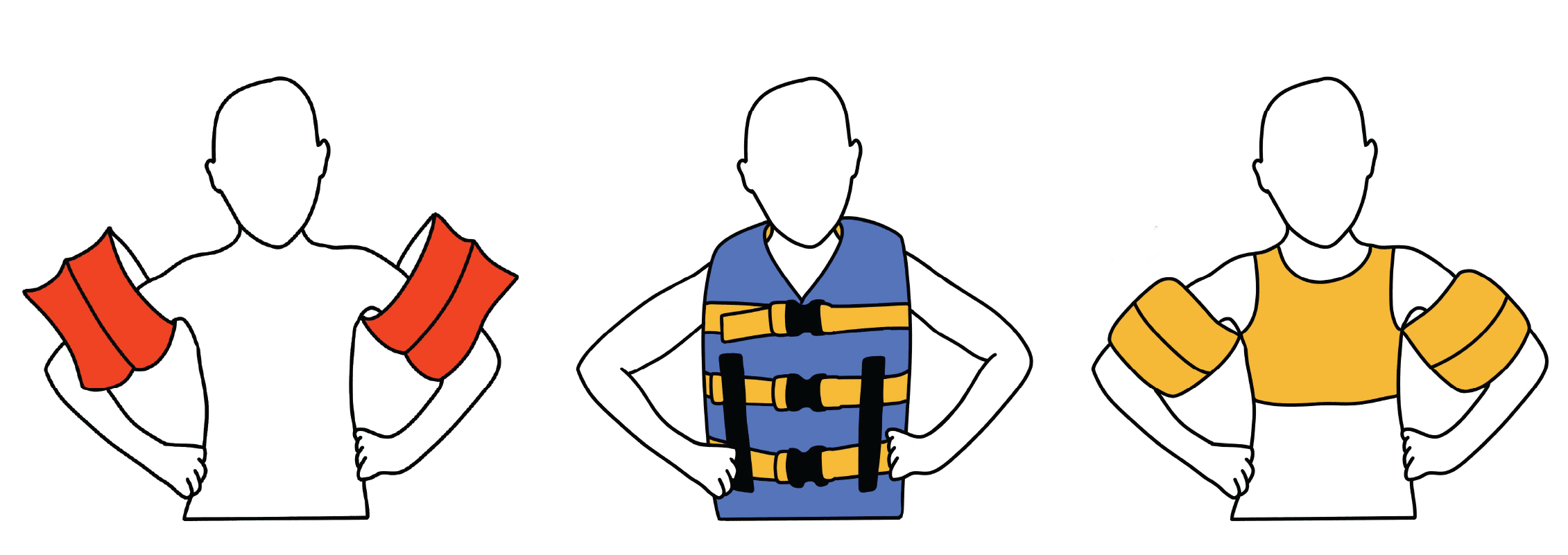
| Inflatable Arm Bands: Also called water wings, floaties, or swimmies. Inflatable plastic, worn one per arm. | Vest-style Life Jacket: A sleeveless buoyant device may be filled with foam or air-inflated. | Puddle Jumpers: Composed of foam-filled pad that sits across the child’s chest, connected to two foam-filled arm bands, and a strap that buckles in the back. |
Many popular swim aids introduce a variety of risks when used by children who cannot swim. Inflatable products, like arm bands, can lose buoyancy by popping or leaking air and can be easily removed. Products like puddle jumpers that keep children in an upright, bobbing position — often called “drowning posture” or “Instinctive Drowning Response” and associated with pushing down through the water with only hands and arms rather than using legs 5 — can train children to instinctively assume that same position, an especially challenging task for a new swimmer, when unsupported in the water.
Using swim aids can provide both the swimmer and the supervisor with a false sense of security. In some cases, children may even believe they can swim independently, not realizing they have been reliant on the device. This belief can be especially dangerous if a caregiver removes the swim aid and a child returns to the water without the device and, potentially, without permission or supervision.
Even when a guardian opts to provide a vest-style life jacket to a child, there can still be risks. One such risk is that a life jacket chosen for a specific use case might not be designated for that type of use. In 2025, a young child in Texas was playing in a lake when the life jacket he was wearing absorbed so much water that his mom said it nearly dragged him under. In this case, the child’s life jacket was a Type III PFD for general boating use, not for swimming in open water 6. Over time, a life jacket for boating might have become saturated to the point of uselessness.
Just as it can be easy to use the wrong type of life jacket, it can also be easy for users to use the wrong size, not realizing that sizing is crucial to a life jacket working as intended. While donning an oversized sweatshirt will still allow the sweatshirt to do its job, wearing an oversized life jacket can allow the life jacket to lift off of a child and even over their head when they are underwater.
Selecting the correct type and size of life jacket is critical, but another risk still remains: some life jackets on the market are not actually life jackets at all. These so-called fake life jackets, which have been associated with drowning deaths in refugees 7, might look just like lifesaving life jackets, but their foam is not buoyant enough to prevent sinking. Some fake life jackets may even make claims that they are safe, using misleading labels to confuse consumers; for example, it was only after Allie Wojack purchased a well-reviewed life jacket online that she found out the “Intended use: Swim vest for kids,” marking did not mean that it was a lifesaving device.
Even keeping all of this information in mind, browsing for PFDs online or in stores may result in being deceived by fraudulent certifications which, while appearing to be official, are considered counterfeit 8. Faced with a market saturated with unsafe options for swim aids, consumers must familiarize themselves with identifying products that are certified to the appropriate safety standard.
Question
What are the most important features of a PFD? How does this consideration change when thinking about different users — adult versus child? Or in various use cases — boating versus swimming versus kiteboarding?
Approach
The U.S. Code of Federal Regulations Title 46 CFR requires that life jackets be provided for every person on board a vessel in open water to give some protection from drowning. U.S. Coast Guard-approved life jackets have evolved over time. The first life jackets were made from natural buoyant materials such as cork, kapok, or balsa wood. In more recent years, foam and air have become popular in both static and inflatable belts, vests, and jackets, depending on the specific use case. In addition to the CFR, local efforts to increase use of life jackets include ordinances which make them required, parental modeling, educational campaigns, and improvements to life jacket accessibility, such as loaner programs at boating and swimming sites. But even with more people using life jackets, if the devices themselves are not safe, the risk of drowning is not mitigated.
To help identify and certify safe life jackets, UL Standards & Engagement adopted the first edition of UL 1123, the Standard for Marine Special Purpose Water Safety Buoyant Devices, in 1971. The next year, the U.S. Coast Guard named Underwriters Laboratories Inc. (in a position now held by UL Solutions) the official testing service for PFDs. Initial requirements for certification of a PFD to UL 1123 included a capability to turn over an adult body lying face down in water within 15 seconds and a buoyancy capable of holding a user’s head above water.
Although there are regulated requirements for life jacket use on open water, no such regulation to support the use of specific life jackets in non-natural water, such as pools or spas, currently exists, which leaves the decision on which flotation devices to use in these instances — and whether to even use them at all — up to the consumer.
While the UL 1123 requirements for certification published in 1971 laid a foundation for PFD safety, they did not address children in and around water. And because U.S. Coast Guard data showed no reduction in child drowning deaths, updates to testing and certification protocols were made to better address the unique risks posed by child-specific flotation devices such as arm bands and puddle jumpers. As additional recreation activities for adults such as kiteboarding or board sailing took off in the early 2000s, it was recognized that the safety standard needed to be updated to protect users of all ages, and such updates were then made.
Question
Hooks and other physical devices can change the way that PFDs function. Consider two cases where a hook is used on open water: Why would you need a separate test for the hook used in board sailing? What about a rescue worker in swift water? What test might you suggest?
Solution
Safety standards help producers and consumers confidently say whether a product will work in its intended environment, is durable, and is safe to use. Now the Standard for Marine Buoyant Devices, UL 1123 is currently in its seventh edition and under continuous maintenance. In particular, changes to UL 1123 made PFDs certified to the standard safer for children as well as adults. The standard provides safety guidance for manufacturers to create compliant life jackets for maritime use. The U.S. Coast Guard and Transport Canada require that life jackets, vests, inflatable devices, and static throw ring-type objects meet UL 1123 to be certified for carriage on commercial and recreational vessels in the U.S. and Canada, respectively.
There are many types of PFDs covered by this Standard:
- Type II PFDs: near-shore use life jackets are intended to turn an unconscious person from a face down position in the water to a position where their respiration is not impeded and to be used in near-shore applications, such as general boating in calm, inland water, or where there is a good chance of a quick rescue.
- Type III PFDs: flotation aids are intended to support a conscious person in the water in an upright position and to be used for general boating or other specialized water activities on calm, inland water, with specialized shapes that support boating activities. As these devices may be cut smaller around the torso, with more room around the armpit, Type III devices must allow the wearer to maintain a related static balance without impeding breathing, should not turn the wearer face down while in an upright position, and must not ride up more than 6 inches above the shoulder while floating so that the device does not obstruct vision or breathing.
- Type IV PFDs: are intended to be thrown to and grasped by a person in the water and, in the context of UL 1123, include horseshoe buoys and ring buoys, with or without lifelines. These devices do not provide means for adjustment or close fitting to the body.
- Type V PFDs: special use life jackets are special-use devices, such as boardsailing vests, deck suits, commercial whitewater vests, overboard rescue devices, law enforcement flotation devices, and more.
You might be wondering how a standards testing organization — or a consumer, for that matter — could know whether a life jacket is indeed good enough to work quickly and sufficiently in an emergency or out-of-control situation, even when the user may not already be wearing it. The answer lies in the requirements of UL 1123: for a product to be certified to this Standard, it must pass a series of tests designed to demonstrate its likelihood to function to save a human from drowning if an incident occurs in or on the water. Many of these tests compare the performance of the candidate device, or the device being evaluated, with the performance of an equivalent reference vest, or standard USCG vest — Model AK-1 for Adult, Model CKM-1 for Youth, and Model CKS-2 for Child Small and Infant.
One such test is the donning test, which specifies that, when put on the body by the wearer, a PFD must be fully donned and ready to function as needed within 60 seconds. To perform the donning test, human test subjects of varying height and weight, the number of which is dependent upon the candidate device’s chest size adjustment range but must include at least one male and at least one female, are instructed to don the device as quickly as possible and adjust it to a snug fit while being timed.
Type II PFDs specifically, which are intended to be able to turn an unconscious person out of water, must comply with the requirements of the turning test to be certified to UL 1123. During the turning test, which mimics a boater losing consciousness either before they hit the water, as they hit the water due to impact with the surface, or after hitting the water, such as in cold water events, a test subject wearing the candidate device relaxes face down in the water, exhaling slowly, while the turning time is recorded. To comply with the test, the amount of time a Type II PFD takes to turn a face-down person must not exceed that of the reference vest by more than 2 seconds for youth and adult devices or more than 1 second for child and infant devices; furthermore, the total number of turns for the group of test subjects must not be less than the number of turns obtained by using the reference vest.
A third test required for compliance with UL 1123 which mimics real usage scenarios is the water entry test, which specifies that a PFD must remain securely in place and provide adequate support when a user jumps into the water with their arms extended above their head — an action that can cause the PFD to shift or rebound over the user’s head. To counter the risk of a child jumping into a pool and their PFD behaving in an unpredictable way, child devices are tested using child test subjects.
In addition to performance testing, UL 1123 also requires that PFDs are provided with specific markings labels, the contents of which include but are not limited to sizing information, appropriate performance level, and applicable warnings and limitations. Consumers are advised to look for U.S. Coast Guard (USCG) certification codes on PFD labels and to search for those codes and manufacturers on USCG’s certified equipment list.
Two labels that are required for UL 1123 certification are the selection and inspection labels. The selection label informs the user that they should select an appropriately sized jacket for the user and for the activity. It is crucial to fit a PFD to the person using it. For children’s devices, users should be within the device’s intended weight range ±1 lb (0.5 kg) and intended chest size range ±1 inch (25 mm). If a child’s weight or chest size is outside the intended ranges of the device they are wearing, the risk that the device will not work as intended increases significantly. Therefore, it is important to monitor that a child’s PFD is still appropriate for them as they grow. The inspection label reminds users to inspect their device before every use for indications of wear or damage that could reduce its functionality.
While UL 1123 has requirements that critically improve the safety of flotation devices that are available, as noted at the outset, such devices can only be effective if they are available and worn. So, members of the public also need to be vigilant about using certified devices and following user instructions.
UL 1123 provides a blueprint for manufacturers, helping them test their designs for many potential threats to provide flexible safety for everyone on and near the water. As technologies and recreation change over time, the engineers of tomorrow will have the opportunity to design for safety by following safety standards like UL 1123 and to contribute to the development of UL 1123 as they invent ever-safer solutions to avoid drowning. With increased consumer education and consistent manufacturing certification, a future with fewer children drowning is possible thanks to certified PFDs.
A standard is a critical tool for ensuring global problems are addressed through iterative, collaborative problem-solving.
This is just a small recap, and you are encouraged to view the standard, in full, for free, by creating an account at ShopULStandards.com and using the Digital View feature.
Discussion Questions
- The Technical Secretariat of the National Council for Accident Prevention recommends the use of personal flotation devices for the infant population, noting that no toy can replace the safety provided by a life jacket. How would you instruct toy stores to handle the confusion between toys and certified PFDs?
- Water safety is an issue that impacts everyone. What are some productive questions or conversation starters you could use to share good advice about selecting and wearing a certified PFD to prevent drowning?
- According to data from the U.S. Coast Guard, there was a sharp but brief and narrow increase in pandemic-era drownings increase in drownings during the COVID-19 pandemic from 2020 to 2022. What factors pertaining to a global pandemic could have caused this increase? What lessons can be learned from this increase to inform human behavior and prevent drowning in the future?
- Thus far, national drowning prevention strategies have only addressed open-water safety. Do you think national actions should be taken to address water safety in pools and spas in private or public spaces? What recommendations would you make?
Glossary
- Buoyancy
The tendency of a body to float or sink in water or any other fluid. Most people will naturally float in water, especially if they fill their lungs with air.
- Face Plane Angle
The angle, relative to the surface of the water, of the plane formed by the most forward part of the forehead and chin of a wearer floating in the attitude of static balance in which respiration is least likely to be impeded.
- Freeboard
A distance measured perpendicularly from the surface of the water to the lowest point where the wearer’s respiration is able to be impeded, typically to the corner of the mouth.
- Kapok
A natural silky fiber produced from the seed of the kapok (ceiba) tree which floats because of air trapped in the fibers’ hollow cells.
- Plastic foams
Materials consisting of closed plastic cells which trap air and provide flotation. Flexible plastic foams used for buoyancy include polyvinyl chloride (PVC), polyethylene (PE), and Neoprene. Rigid foams used in ring lifebuoys are often polyurethane (PU).
References
- Lister, R. B. (2025, May 29). Drowning Really Is Silent: What Parents Need to Know This Summer. TODAY.Com. https://www.today.com/parents/drowning-silent-nightmare-day-pool-t23881
- Cohen, R. (2025, August 28). Emilie Kiser speaks out for the first time on son’s death: “I should have done more to protect him.” NBC News. https://www.nbcnews.com/pop-culture/pop-culture-news/emilie-kiser-speaks-first-time-sons-death-done-protect-rcna227805
- Anderson, K. R., Ramos, W. D., & Schuman, J. T. (2021). The Role of Permission, Supervision, and Precipitating Events in Childhood Pool/Spa Submersion Incidents, United States, 2000–2017. International Journal of Environmental Research and Public Health, 18(16), 8776. https://doi.org/10.3390/ijerph18168776
- Denny, S. A., Quan, L., Gilchrist, J., McCallin, T., Shenoi, R., Yusuf, S., Weiss, J., & Hoffman, B. (2021). Prevention of Drowning. Pediatrics, 148(2), e2021052227. https://doi.org/10.1542/peds.2021-052227
- Vittone, M. (2010, May 3). Drowning Doesn’t Look Like Drowning. https://mariovittone.com/2010/05/154/
- Owens, R. (2025, July 23). North Texas mom says faulty life jacket nearly drowned young son. CBS Texas. https://www.cbsnews.com/texas/news/north-texas-mom-says-faulty-life-jacket-nearly-drowned-young-son/
- Fake lifejackets play a role in drowning of refugees. (2016). Bulletin of the World Health Organization, 94(6), 411–412. https://doi.org/10.2471/BLT.16.020616
- Good Morning America. (2025, August 11). Safety alert on counterfeit life jackets. Good Morning America. https://www.goodmorningamerica.com/video/124537952